

Finding the right time to contact your customers and prospects has been, and continues to be, one of the great challenges in the outbound contact centre. Data Science and Artificial Intelligence (AI) are being applied to inbound contact centres. What about AI in the outbound world?
Why is finding the right time important?
Ask any outbound contact centre manager – especially those using a predictive dialler or other outbound automation process – and they will tell you that ‘fresh’ data is the best data – you stand the best chance of making that sale, booking that appointment or collecting that debt if you talk to the right person on the first or perhaps the second contact attempt. The law of diminishing returns applies if the contact centre simply cranks up the team to attempt to contact more often.
The chart below shows the typical shape of positive outcomes by contact attempt.
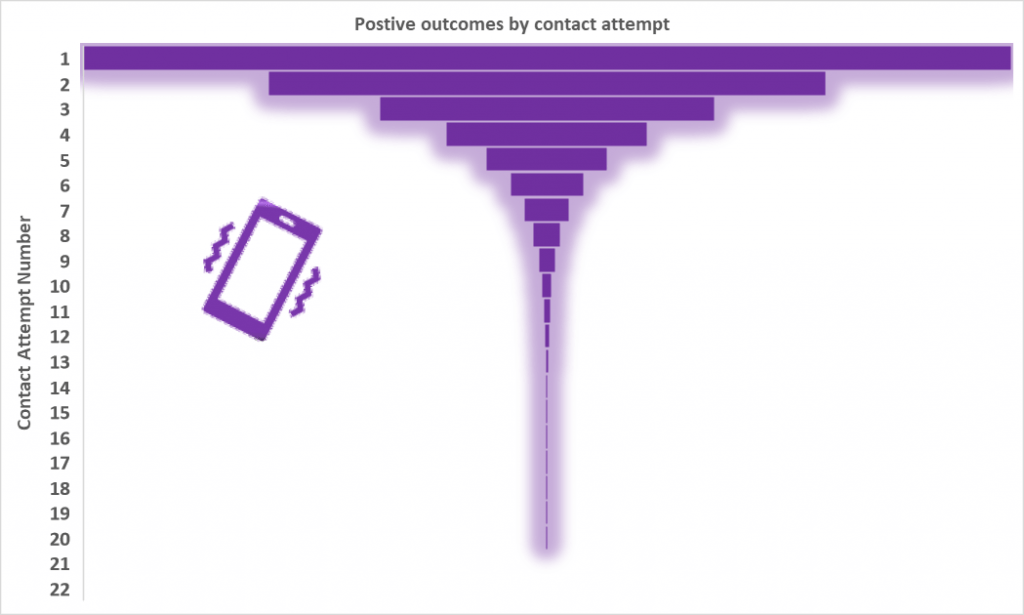
The bulk of positive, right-party contacts are made in the first few contact attempts. Positive outcomes quickly drift away. If you make more attempts you will make some contacts but the cost-benefit analysis usually doesn’t stack up. In today’s regulated contact centre the cost of agents waiting for the next person to talk to or dealing with answer machines can outweigh the business value.
When is the right time to contact?
The full answer depends on the contact centre’s audience but let’s look at the general case of a business taking to consumers. Right party contact rates follow a time-of-day pattern.
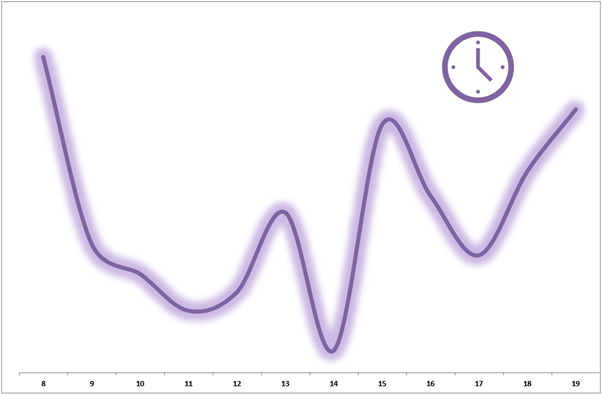
Contact rate starts well in the morning – before work and the school run – hits a downward slope before a small peak at lunchtime followed by a lull until late afternoon and evening after returning home. Intriguingly this long-established pattern has barely changed as mobile telephony has predominated and home working became more common – it seems that consumers continue to follow familiar routines and the ‘Right time to Contact’ can be read off the chart.
The blended contact centre challenge
Many contact centres operate with blended operations – agent teams handling both inbound and outbound contact. Observant contact centre managers see that the right time to contact chart above has clear correlation with another chart – the inbound contact rate.
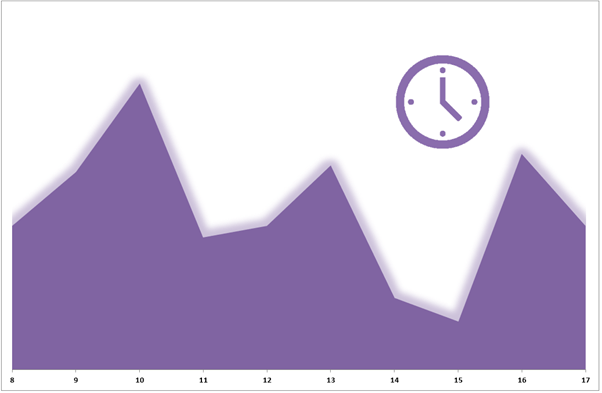
The rule of thumb is that the best time to contact customers and prospects is at the same time as they are contacting you. But of course, your agents can’t be simultaneously deal with inbound service requests and make outbound phone calls. There is a good reason why contact centres don’t overlap inbound and outbound contacts during peak hours; whilst it would be effective for outbound contact rates, which means that it’s difficult to employ people to work for, say, two frenetic hours in the morning and four similarly busy hours in the afternoon.
Applying intelligence
The right time to contact challenge has transformed to targeting your audience as a set of individuals and applying data science – artificial intelligence, machine learning or other techniques – to assess the best time and best medium to contact.
Applying intelligence to a right time algorithm is predicated on the idea that you have some knowledge about each customer – you may know when they usually call you, or when they tend get in touch via digital channels; they may have created a quotation so you when that they’ve been active. You should be able to look at your inbound records to pinpoint the best time to contact.
Valuable data is captured in all areas of your contact centre – inbound and outbound calls, emails, tweets and chats – to give you valuable insights.
If you don’t have, or can’t easily compile, a history of the contact, you are cold calling for example, clichéd thinking can work until you start building your own algorithm. For example:
- call the over 60s in the afternoon
- if you know someone has young children, avoid school run times
- if you have a London post code call later in the evening
There are all sorts of possibilities to consider when inferring the right time to call but the benefits are valuable.
Yes, but…
“my systems don’t make it easy to analyse the historical data”
“we don’t have the data science skills in house”
“I need to demonstrate the business case”
I’m familiar with these and other common objections to simply getting started on the road to increased contact performance. If you would like to learn about an alternate route, which means that you avoid doing all the hard work yourself then get in touch and let me convince you.